Showing posts with label self-development. Show all posts

Saturday, 1 October 2016

When to change plans? Ask tarot

One of the most common questions tarot readers get is along the lines: should I keep doing what I'm doing, or change the plan and do something else?

This question repeats in every area of life: studies, work, love and relationships with loved ones in general. It is, indeed, tricky to know when to continue and when to change course. The main problem, however, is not necessarily lack of knowledge, new ideas or plans, it's this:

8 Swords.
8 Swords, Rider Waite Smith tarot.
Often in life, when we've been putting in a lot of effort on something, it feels unbearable to think that no fruit came of it. Changing a plan feels like a failure. We often don't feel at ease to quit studies, change careers, change partners or cut out friends, even when it feels there's nothing but roadblocks. The feeling of a roadblock is real, but here's the catch: the roadblock itself is not.

Tarot card 8 Swords symbolises a situation where we can't see a way forward. We're so set on one course or one thinking pattern, that we don't realise nothing else but our own worries, assumptions, expectations and beliefs are stopping us. There's always a choice - a different choice.

8 Swords of Anna K tarot shows, how the feeling of being trapped is just a projection or illusion. The person is free, holding a sword - symbolising power, knowledge and clarity of thought - but she believes she's trapped. In reality, nothing but her own thoughts are keeping her captive.
I once read that an average person makes thousands of choices every day without counting them.

We decide whether to get up or not. Whether to have breakfast or not. What to have for breakfast? What to wear for work? To go to work at all or not? Do some pilates before work or not? Catch a bus or drive? Start with task A or task B? Have a chat with Bernie or Bonnie? Leave early or stay late? Shop at Fresh Groceries or Fresh Produce? Send a few job applications at night? Sign up for couples' counselling or not?

Now, usually it feels that these are not actual choices. Many are self-evident, automated motions we have to carry out to simply live life. But, from a philosophical point of view, they are all choices. And if we chose differently, our day and life would be different.

8 Swords is the mindset where things happen and thoughts are thought, because that's how it's always done. But technically, we could NOT go to work. NOT talk to Bonnie the Boss, but Bernie the Jovial Friend. NOT go shopping at all but drive to Vegas to spend all our money, never come back and forget our job and marriage troubles forever.

Maybe not the best decisions, but decisions and choices nevertheless. And if any of the daily choices are different than usually, the day is different and can gradually produce a different life, when changes and different choices accumulate.

To wind back to bigger life choices. How to know when a change of plans is in order, and how to encourage oneself to take that step?

It can feel daunting to admit that nothing came of this field of studies, career, or relationship. What will everyone else say? How will I be viewed? How can I justify to myself or others I've spent so much time on this, and now I've got no results to show?

This, again is the 8 Swords: feeling trapped due to thoughts. Thoughts are only mental constructions and ways to see the situation, and they can be changed: negative, limiting thoughts produce trapped behaviour; whereas positive, expansive, curious thoughts produce new choices, new plans, new vistas.

I used to do a lot of knitting and that was a hobby that thought me the necessity of sometimes going back and fixing things from the root. If I made a mistake with the pattern, it could not be patched up later on. My creation would very visibly show, almost radiate the fact there was an error. I often had to undo what I had knit, unravel perhaps an hour's work. What a pain. And yet, it simply had to be done to get the best result. If I'm putting a lot of effort into something, why accept grade C quality?

Life is a lot like knitting. We try to create something the best we can, sometimes we follow a pattern, sometimes we wing it, but in every case, if there is a mistake made or wrong turn taken, we might need to humbly go back and do it again - change course, no matter how late it feels.

Nobody excels at living and nobody's life is error free. So let yourself out of the mental jail and stop judging your earlier choices; more importantly, stop listening to anybody who judges your choices.

If something needs to be changed or fixed, don't be afraid of unravelling. What you build next can be much better. At least it's different, and a source for different lessons.

Here's a spread that can help (pull 1-3 cards for each question depending on your preferences and skills).

When and how to change plans?

What in my life needs to change?

To what direction should the change be?

What action to take to change it?

What have I learned from going through this path until the change?

What in my life needs to stop altogether?

How to stop it?

What in my life needs to start?

How to start it?

Tarot cards 8 Wands and 8 Cups symbolise taking action (or communication); and realising that something does not bring joy any more or won't become fulfilling, no matter how much we try. So, it's better to move on and take action to change plans.

Sunday, 25 September 2016

Tarot as a moral compass

Studying tarot has been a major eye-opener or rather, a mind-expander, for myself in the areas of a world view, values and thinking patterns. Since I started reading tarot, I've become more mature, calm and zen in life in general. How and why did that happen?

When I first stumbled on tarot some five years ago, I was mostly curious about its symbolism - I have a degree in art history and I've been drawn to understanding and deciphering symbols and codes since the start of my studies, in the best Dan Brown / Da Vinci Code manner.

Quite soon, I became enticed by tarot's divination skills: how could such a thing possibly exist and were the divinatory "powers" tarot clearly seemed to have (based on my Excel spreadsheets I kept to track my predictions) merely an illusion or a real thing? And if they were a real thing, how could that possibly be true from any scientific point of view I knew?

After encountering tarot, I became less enthusiastic about the reductionist, scientific and rather simplistic world view (matter is all there is) and other, more layered, metaphysical explanations started to make more sense.

I became more and more interested in the Eastern spiritualism (inc. Buddhism, Taoism etc.) and later on, on the traditions of Western Mysticims, including New Age but also other streams such as the Golden Dawn (one of the occult societies that created their own version of tarot cards in the turn of the 19th and 20th centuries), Theosophy, Druidism, Wiccan etc.

I don't subscribe to any religion or specific spirituality, but perhaps Theosophy hits closest to home with the idea that everyone should study and learn from every possible philosophy, religion and spiritual tradition, to form their own views and be as informed as possible = to be the lovers of wisdom, theo sophists.

I have not concluded how it could be possible that tarot can have any divinatory powers. The cards definitely seem to have them, for sure. I have predicted, for instance, meeting my husband, certain events happening at work, a couple of major arguments coming up with close relatives, and so on. I'll discuss my theory later on. Today, I'm more interested in discussing the "we see what we focus on"-theory.

I think that at its most rudimentary level, tarot is just a trigger for intuition in the same way than clouds, flames, foliage, or even wallpaper patterns can be. The human mind is incredibly apt in finding patters, forms and images - making meaning - where there is none. I believe we see patterns and images in the clouds, tree canopies, in the fur of our pets and practically, wherever, because we project what's in our mind anyway.

Tarot is all about looking at pictures and understanding their symbolic meanings. Normally, cards are rich in imagery and there is always something different to focus on. For one person, a white lily in the picture jumps out, because s/he is contemplating a matter that relates to innocence, children, purity of thought etc. For another reader, a medieval sword in the picture draws attention because his/her mind is occupied with thoughts about arguments, need for clarity, painful/hurtful words = blades etc.

People in general see meaning where it is only hinted - to the point where it becomes a problem. Think of all the times you - or perhaps your significant other - read something between the lines and it was, in fact, completely off base, only brought into existence by your own fears or hopes?

With tarot, the trick is to see meaning, but not too much of it. Intuition can't be paranoia or wishful thinking. How to find the exact amount of gut feeling? With practice. We know much more about life, ourselves and other people than we realise, but that requires careful tuning into the quietest wave lengths of our mind: it's about hearing the whispers, the hunches, the tiniest signs we've captured earlier without realising it.

As mentioned at the beginning, tarot has had a very educational role in my own life. When I focus on the tarot cards, I see messages of wisdom, patience and good will. Cards that repeat in my readings, highlight issues and recommend ways to fix things. For example, I have made a deliberate effort to become less fiery/trigger happy and more understanding and emphatic in arguments, because of the repeating message I've picked from the cards. Of course, the repeating cards can be a mere coincidence. And still, after I've understood and incorporated the message, the repetition stops.

Seeing messages in tarot or in any other medium can be explained by the fact that the human mind is tuned to see  meaning everywhere. I've seen meaning in random cards and it is not necessarily anything mystical. On the other hand, if seeing meaning improves the quality of life, is that a bad thing or wrong? Of course not.

Why and how has tarot made me calmer and more mature? I think it's partly because of self-reflection the cards give prompts for; and partly because of the divinatory properties.

Whether or not I can prove that the predictions are true, I feel that I can know what's coming up and there is a reason why certain events happen. That makes me much calmer towards any upheaval or sudden change in the future.

With advance notice, there's less reason for stress. And with the world view that everything happens for a reason and contains a lesson to draw from, hardly anything is scary. It just is. We always have a chance to decide, how to feel about matters, how to react, what action to take, how to fix or change or adapt into the situation.

I think that tarot in itself can be a way of life. Reading cards is often accompanied by some spiritual world view, but not always. Perhaps the only thing that connects all the readers is the idea that random pictures can trigger the intuition to know more than it otherwise could. Tarot is, at its core, about expanded knowledge, wisdom, and understanding of oneself and others.

Tarot to me is an inherently empathetic messaging channel; to me the cards always show the high road, the better way, the more moral take on the issue. Perhaps it's nothing more than a reflection of my own subconscious, but luckily my subconscious seems very concerned about the well-being of others AND myself, and hence, has helped me to become a better person. Thanks tarot! :)

Can the cards really know what's going on or what should be done? Actually, it doesn't matter. It's the reader who makes sense of the pictures and finds meaning in patterns with his/her intuition. 

Wednesday, 6 July 2016

Difference between possible and impossible

I joined a new pilates/yoga studio a couple of weeks ago and go often, partly because it's energising, partly because it's direct debited fortnightly for unlimited access, so I better get value for money!

I've practised yoga sporadically for five years now (sometimes multiple times per week, sometimes not at all for a month or two) and it's an activity where you gradually and reliably see the change in your skills, flexibility and balance. Slowly, slowly at first, but faster once you get the hang of it. Of course the main purpose is to learn to be more mindful, calm and centered, but the physical, fitness side is a great addition, too.

Yesterday, someone new joined my pilates class: an overweight 50+ lady. She struggled to keep up, which is more than understandable. Starting from zero is always hard, and it takes courage to join a class where you feel others are more fit and skilled than you. The teacher kept encouraging her in every turn and teaching her different methods to not make it all too challenging.

However, the new lady kept finding reasons (excuses?) why she can't do more than a couple of repeats per move. Instead of at least trying and persisting, she complained about cramps, panting, sweat, how it all feels uncomfortable. With every change of body position, she shuffled a good long minute longer than others - which made her drop out of the others' rhythm, then apparently feel she can't catch up anyway so she simply waited for the beginning of the next series of moves. And the same shuffling, delay and drop-out again, throughout the class.

This sounds judgemental and I admit I struggled with not judging her, but she was only harming herself by giving up from the get-go. Any type of exercise feels awkward and uncomfortable from the start, when you're not yet familiar with how it should feel and how great it can feel afterwards. She wasn't pushing herself, because she had not (yet or ever?) learned, that developing strength, balance and flexibility takes a few weeks to notice. Rewards don't come immediately and you don't even get the post-workout euphoria if there's no proper workout.

Of course I can't know what were her reasons for not persisting. But I've heard many times before people complaining how they exercise or diet and no results come. There is a good chance the exercise is not actually done as effectively as it should be: attending a class is not the same as actually doing a workout, pushing yourself, challenging and persevering.

The moral #1 of the story is not to judge anyone who's struggling with weight of fitness. It's to remember that everything in life takes work, effort, energy, time to succeed.

Yoga has actually taught me the meaning of the Hanged Man tarot card: it's about self-sacrifice, voluntary yet frustrating waiting, changing one's viewpoint instead of changing one's circumstances. Sometimes you must stay in an uncomfortable (yoga or life) position for longer than you'd possibly like, because it's good for you in the long run. And you'll only see the benefits later, after sufficient time - weeks, months or years.

The moral #2 of the story is: whatever we tell ourselves, we believe, and that becomes our reality. "It's too hard, it can't be done, I'm not fit enough, I'm not skilled enough, I don't know what to do anyway, everyone else is better than me, I can't succeed because everything and everyone is against me, I just have a body type that won't allow me to change, etc."

I've worked in four different fields, tried and played any sports I can think of, moved to new countries and travelled wide and far, because before embarking on any of these quests, I've told myself: "others have done it, I can do it too." And believed it. The usual limiting suspects, such as time, money, lack of skills etc. are not an actual, physical barrier, if you plan and prioritise differently.

Very few things in life are outright impossible, but a good number of things are at least semi-possible if you set your heart to it and stick with it. No excuses, no dodging, no giving up when the first roadblock comes or the first cramp hits.

If you can't achieve your full dream, maybe you can achieve at least half of it? 

With weight loss, maybe half of your target is better than no loss at all? Acquiring new skills: learning the basics of a new language is better than not learning at all. Changing jobs: finding a lower-paid position in a field that interests you is better than no change at all. Dating: putting yourself out there to learn confidence and socialising skills is better than not even trying, even if you don't find the Prince/Princess Charming immediately. And so forth.

And here's a tarot spread I created for identifying roadblocks and ways around them.

POSSIBLE OR IMPOSSIBLE? 
Pull 1-3 cards for each question depending on your interpretation skills and reading preferences

  1. What change or achievement I believe is not possible, when it actually is? 
  2. What can I do to make it happen?
  3. What negative situation or trait in myself I believe is permanent, and it's not?
  4. What to do to change it for better?
  5. What change or achievement for now is out of my reach? 
  6. What can I do to achieve or change some of it? 
  7. What trait in me helps me achieve goals?
  8. What trait in me hinders me from achieving goals?
  9. What to focus on to be the best possible version of myself?
And a sample reading:

1)  7 PENTACLES. This card is often read to meant "waiting for results", as it shows a person waiting for fruit to ripen. I read this to mean here: accumulating wealth, as my card shows a mother and a child ready to pick massive, plump apples.


2)  EMPEROR. This card means a structured, organised and assertive approach; stability and permanency. I think it means: accumulating wealth can happen with hard work, logical approach and wise investment decisions.

3)  7 WANDS. The uphill battle I'm currently in with my PhD studies and work. I'm doing my best to tackle all challenges, yet it feels I'm not moving forward at all. More issues and tasks pile up on me no matter how fast and well I work.

4)  9 PENTACLES. The card of enjoying one's freedom, independence, wealth, experience, achievements. Maybe I should take more time for myself, to enjoy my freedom and things I like. And also remember and appreciate the fact that I'm actually quite free both at studies and at work to handle things as I please.

5)  8 WANDS. Fast-paced action and messages bearing good news. I'm waiting/hoping for good news from multiple fronts regarding my studies and a creative project I'm undertaking, but clearly the action won't be fast in those areas. Well, good to know.

6)  3 CUPS. Find like-minded people, join "my tribe", enjoy company of friends. My friends, indeed, are helping me with the creative undertaking. Also, I should do more research online to find the best community, as I'm trying to find a University department to join next year as a visiting scholar.

7)  4 WANDS. The card of home, completions, celebrations. I work full-time in the office but I also work at home on my own stuff, which I truly enjoy. Also, I divide tasks into chunks that are easier to complete than the whole project, and I mark the mid-completions with celebration. It works!

8)  LOVERS. I believe I should only focus on things / people I love in life. However, this is not possible, because many tasks are simply boring, but necessary steps on the way to bigger achievements. For example, I'm much more prone to fiddle with my tarot cards in the evenings than read PhD material... and I should not let my heart dictate what I do so much!

9)  5 WANDS. The card of conflicts, frustrations, competition. I don't think I should be more anxious or frustrated, but maybe I should put myself out there to compete more: I can't achieve goals if I shy away from competition. However, as I am quite competitive already, I'm inclined to read this as a reminder to keep an eye on this tendency and only use it in appropriate occasions - fight for your goals when needed, but let others win where necessary to keep the balance right. 

I hope this offers interesting insights! 
Forge your own path marked with successes and joy. Photo (c) Tarot for Change.

Thursday, 23 June 2016

Who am I? - reading

Hello all again, greetings from Europe and Egypt. For the first time in 15 years, I had a chance to take a break longer than a month and boy did I enjoy it! Anyhow, let's move on straight to today's spread that I devised. It's about exploring yourself.

Me, myself and I

What is my core personality like? QUEEN OF CUPS. 

This Queen lives in the world of emotions, positive and negative. Everything in life is experienced through emotions first and foremost, not through logic and analysis, for example. Emotions can sometimes take over and be difficult to control. This Queen spends her time in experiencing and exploring different 'vibrations', living every day in the heart rather than in the head. Intuitive and introvert rather than logical and extrovert.

What makes me happiest in life? 6 SWORDS Rev. 

6 Swords upright is a card of leaving worries and turbulent thoughts behind, but reversed, it doesn't simply mean "arrival of worries". Rather I read it to mean - arrival of thoughts. I do love learning, reading, conversing... all methods of finding new information and things to ponder. This could also mean "ditching worries", the thoughts (swords) are not in the boat at all but are tipped over and vanish for good.

What strength do I have I take for granted? MAGICIAN.

The Magician is someone who can turn thoughts, plans and ideas into reality - can make things happen. The Magician does not only dream of new things or new directions, s/he brings them forward and makes them reality. Some people read the Magician as a con artists, but I don't believe in that interpretation as a sweeping generalisation. Sometimes the Magician can be a negative card, but the core meaning for me is: someone who can manifest their will in the world and take action to follow through.

What unhelpful personality trait or aspect I have successfully left behind? MOON Rev.

The Moon usually points to fears and illusions, things being hazy and unclear, coloured by our own imagination and instinctive, even primal fears. For years, I used to suffer from "existential panic attacks", fear of death in other words. Eventually, with a lot of help from tarot, I "grew out" of it, I don't delve in the otherworld (or the end of life) that excessively. The easing of the fear of death has also eased other fears - after all, excessive fear of death is survival instinct gone mad and that overdrive or agitation triggers all sorts of other fears too.

What is my most beneficial personality trait from others' perspective? 8 CUPS.

I don't hold grudge or regrets, I move on. 8 Cups is a card of leaving an emotionally draining or negative situation behind for good, going on a quest to seek for new fulfilment. There's no delving in negativity or memories, there's straightforward action of putting a stop to it and moving on.

What is my most beneficial personality trait for myself? WORLD.

The will and keenness to learn, to complete, to become the best possible version of myself. The World is a card of achievements, completion, lessons learned, things coming together to form a whole book instead of individual chapters or sentences. It is not so much about ambition but the will to do and know what there is to do and know, to elevate oneself to the next level of understanding and experiences.

Who am I growing to be (what direction is my personality evolving)? 9 SWORDS

9 Swords is a card of excessive worrying, losing sleep over troubles or issues that, in fact, are not that serious after all. This is a card I don't really recognise in this position. Yes, I occasionally worry about all sorts of matters in life and love, but I don't think it's taking over other personality traits. This card often pops up for me, though, in situations where the answer is "duh, you know it, don't ask." It's like tarot's "quit being helpless, will ya?". My deck seems as blunt as I am :D

I feel I'm evolving and maturing in general so I sort of knew the answer and indeed, I got a clarifying card the Strength: the card of zen, control of emotions and impulses with willpower.

What should I do more to support my growth? 2 PENTACLES.

2 Pentacles is a card of a balancing act, juggling two things that are of equal importance. It can talk about two people, or it can mean work/life balance, or other matters that require equal focus. For me this card has a personal meaning and it talks about my professional career and my "side career" of a range of creative undertakings, including this blog and tarot services: live both sides of life to the fullest with equal attention and no neglect.

What should I stop doing to support my growth? QUEEN OF SWORDS.

This Queen is analytical, clear-headed, straightforward and honest to the point of being blunt. This Queen lives her life through head and analysis: no stone is left unturned, no emotion unanalysed, no motifs, words or actions without scrutiny. I usually identify with this Queen because she's not just an analyser and thinker, she's also a communicator, observer of life and love. However, recently I've been slipping on the side of overanalysing (other people's words and actions and my own feelings regarding those) so it's not healthy to get stuck  in one's own head.

General advise for a better life? 7 WANDS.

Stand your ground, be brave in what you believe in, protect and defend what you hold valuable. 7 Wands is the card of valiant action, standing one's ground even when others are against it, or defending a cause that is under attack. Or, going on with one's plans when others don't support them. One of the most difficult things in life is to find your own standing, to trust your own view when others criticise or attack it, openly or subtly. I think we are all here learning to do exactly this: not to bend under pressure but make our own judgements about what is good and bad, right and wrong, worth stepping up.

I hope this spreads provides insights for self exploration and growth!

Happy light midsummer for the Northern Hemisphere readers!

Friday, 8 April 2016

Everyday happiness series - what we accept, we get

Here's a new post for my everyday happiness - series, this time discussing how we actively co-create our lives by a mere act of accepting. The previous parts are 1# - How to be happier? and 2# - How to quit worrying and envying?

Teaching #3: what we accept, we get

Or, the standards you pass by, are the standards you accept.

How many times have you thought - why am I being treated this poorly or unfairly? Chances are, in average life, that at least a few. Hopefully not every day. But if you think that way every day, this post is definitely for you.

Let's start with a story about my own life. I migrated to Australia with my then-husband (whom I found in my early 20's) years ago, but due to a number of things - huge personality clashes being the major issue - we ended up separating pretty soon after the relocation. I was in a new country with only a handful of (not-yet-so-close) friends, away from all the familiar safety nets such as my family and old friends. To get back on my feet and to manage financially, I decided to find a flatmate.

This flatmate was found quickly and on the outside, she was the sweetest, sunniest thing you can imagine. However, I soon learned that I had walked into a trap. She had her own reasons to live with a flatmate and those reasons revolved around having a crutch to lean on in everything - housework, socialising, and taking care of all of her practical and emotional issues.

Within three months, our cohabitation had spiralled into coercion by emotional blackmail - not a day went by I didn't hear "everyone else would do this for me", "a true friend would do this", "if you were a decent person, you'd do this", etc. The expected tasks ranged from scrubbing the toilet floor, doing her grocery shopping and putting together her IKEA furniture to inviting her to every single social gathering I went (she didn't seem to have many friends of her own, despite the social media appearances).

At first I was happy to help, because I thought it would be a win-win and give-give situation. Of course I can pick a few things in the supermarket for her, too, while I'm there. She had a health condition, so of course I could do some of the heavier tasks. Surely she would help me in turn, too? Right?

Well, that didn't happen. Somehow it was always me doing, giving, helping, taking care of stuff. And not getting a lot in exchange, not even gratitude.

Then, Christmas came and I bought her a present - just something inexpensive as a polite token - and instead of thank you I got an angry response: "now you made me feel bad, I don't have anything for you, why did you do this!". Later on, I learned she was siphoning a portion out of our rent monies so I actually had paid more than needed. I got so fed up I moved out immediately.

The reasons why I tolerated that in the first place were: 
  • I believed her claims that "a good friend / anyone else would do this, why wouldn't you."
  • I didn't have many other people to turn to and I was afraid I'd lose the few friends I had if I actively "rebelled"- I may have been seen as a selfish person if I hadn't helped a flatmate.
  • I had a very nice apartment in the city centre I'd need to give up if I moved - there was no way I could have afforded something as nice on my own.
  • I thought "this probably is how it is for everyone, there's nothing out of the ordinary going on", regardless of the nagging feeling that I'm being taken advantage of.

Now, this is not nearly as severe as being in an abusive relationship or being bullied at work (or school), but it taught me clearly that the phrase "what we accept, we get" is true. If I had stayed, I would have got more of the same and the chances are the emotional blackmail would have spiralled to be worse. I was already losing time, effort and money, I could have been losing my self-esteem and my own life, too - she was actively undermining my dreams and tried to dig a trench between me and my brand new love interest.

I walked out of this experience just with a few surface scratches but it was an eye-opener for why people stay in relationships that are hurtful and harmful. Because it's so easy to slip into thinking that this is what everyone's life is and surely others wouldn't make a fuss out of something this insignificant. Hardly any abuser starts with a full-blown beating - it starts with small but constant undermining and emotional and mental manipulation to make you think you are in the wrong and they are in the right; and you are just being silly and selfish if you don't agree. 

But this is where everyone's inner voice comes at play. Is this right? Am I being treated right? Is this what I want for myself (or for my children/others involved)? Is this the life I dream of?

The same applies to any relationship and situation. Are you disrespected or mistreated at work? Speak up, gather evidence, gather support groups, lodge a formal complaint or leave the place. It won't get better by itself nor by accident. 

Is your partner being unfair or worse, abusive either verbally or physically? Speak up, seek help, leave if needed. I know it's not easy but it won't magically change to better. Someone must take action and if it's not you, who could it be? It won't be the abuser because they are getting exactly what they need by keeping you at bay. 

The same teaching applies to much milder everyday situations, such as someone being rude. Don't take it. Stay firm and don't let someone's lack of manners dig into your personal space. It only tells who they are, not about who you are. I personally stay away from name calling during arguments, because I want to keep the conversation or debate civil. I've never yelled at anyone "you're a fucking idiot", because I would then open the gates to be called the same. 

Here's a tarot spread to examine this topic in more depth: 
  1. What am I accepting from others I shouldn't?
  2. What action can I take to change it?
  3. How am I behaving towards others I shouldn't?
  4. What action can I take to change it?
  5. How to feel more centred and empowered?
  6. How to behave to invite better treatment towards myself?
9 Wands, Witches Tarot. Defend your truth, message and authenticity (8 Wands) with your passion, drive and motivation (Ace of Wands) - don't let anyone walk over you. We all have the same right to exist and become the best versions of ourselves. 

Sunday, 3 April 2016

Everyday happiness - series: how to ditch worries and envying?

This post relates to my series "how to find more everyday happiness?" I mentioned when I started this series that I get to attend courses at work regularly on work life balance, mindfulness etc. and this series is inspired by the most pertinent teachings I've encountered. Here's the first part, Teaching #1: what you focus on, will expand.

Teaching #2: worry and envy feel useful, but are not

Of course, in the idea world, no one would need to worry or feel envious, ever. But in this reality of ours, these emotions come and go with the regularity of clockwork. Firstly, what do I mean by useful? Let's examine.

Nobody worries just for fun or entertainment, duh. We worry because we either can't help it (the thoughts and anxieties just circle around, no matter what else we try to think); or, we feel that by being worried we're actually doing something for the problem.

Think about it. How many times you've caught yourself or someone else saying - if I stop worrying, things most definitely won't improve! Then I'm just letting everything go, letting bad things happen, I'm not being prepared. However, being prepared and being worried are not the same thing.

Worrying is mulling over the same or similar thoughts and anxieties in one's head, all the what ifs and worst case scenarios. It might feel like preparing - after all, it's good to know what to do if the proverbial hits the fan - but is worrying really necessary for planning? Isn't it actually hindering planning, by making you feel more scattered and powerless?

Let's face it. All the worrying in the world will not keep you safe. Things can still go sideways. What's the point in worrying, if you've already prepared as well as you can - worrying won't add anything, it just takes away your ability to focus and enjoy. 

I grew up in a family where my parents worried about money constantly. We had it tight and it wasn't always given that there would be money for that month's grocery bill and us kids only got new clothes three times per year: when the school year started, for Christmas and birthdays.

However, a pressing need can trigger two reactions: creativity and anxiety. My mum was always good at making things by hands and if we lacked something, there was a good chance mum would come up with a crafty idea. My poor dad, on the other hand, probably had a blood pressure peaking to the moon and back. But did that help in any way, if there simply was no money?

The most difficult thing about stopping worrying is to allow yourself to do it. It's so ingrained in our behaviour that if we stop feeling anxious, it's as if we don't care. And that simply is not true.

A wise person once said: if you worry about the war every day and it never comes, you have unnecessarily lived through war. And can worrying stop a war? Well...

Same applies to envying. Nobody wants to envy, or admit being envious. And yet, it's one of the most common feelings. It's just so easy to slip into it when we see someone having what we'd like to have - or worse, feel we should have instead of the other.

Envy might feel justified and useful, just like worrying. What right does my neighbour have to have such a nice car? Or my colleague to have such a successful relationship, beautiful kids and new home? What have they ever done to earn those? I've worked as hard if not more, I should be the one who's rewarded!

Life does not come with a fairness guarantee. It's up to us to decide what to do with that fact. Whether to work harder and try to achieve what the target of our envy has, or succumb to bitterness.

Spiritually minded people think that everyone has their own karma and hence we receive what we deserve. In my view, karma is not punitive but educational. We can always learn from every situation in life. I believe that if we practice and learn more selfishness by being bitter and envious, we'll also get more "bad karma" - but bad karma merely means more chances to learn how not to be selfish and bitter.

Envy is closely related to hatred in the sense that both are toxic for ourselves. Being envious or bitter is like drinking poison and expecting the other to die.

However, worries and envy can be useful if they are used as the initial trigger to improve the situation. 

The future worries you? Come up with your best plan to tackle the worries and start taking care of them, one step at a time - and then, simply relax. There's nothing left to do so you might as well take it easy and let the universe handle some of the stuff, too!

Someone else is successful? Great, that just means it can be done by you, too! Success and love are not limited resources which diminish from the world if somebody makes it. It's quite the contrary. The more positive people feel, the more helpful and encouraging they are towards others, too. Working together instead of against each other always produces better results.

Here's a spread to examine these questions in your own life (just focus on worry OR envy, if not both are your issues).

How to get rid of worrying or envying?

1. What causes me to worry?
2. Why?
3. What action to take to stop it?
4. What should I focus on in my life instead?
5. What causes me to envy?
6. Why?
7. What reminds me not to envy?
8. What is something I have that others wish they had?

Be the King of Fire (Wands) of your own life: authentic, confident, worry-free and fun-loving leader. There's no point in envying or worrying. Joie de Vivre tarot, Paulina Cassidy.

Thursday, 17 March 2016

Why everyone should have a tarot reading?

Yes, I'm a tarot reader and this topic might sound like a marketing blurb, but I actually have a deeper point.

I've mentioned before that I'm a PhD student and I'm currently writing my thesis revolving around the themes of quality of life and quality of urban environment, and the connection between them.

Due to and alongside my studies, I read a lot about experience economy and the importance of meaningful experiences in life. Helping to improve everyone's quality of life is a passion of mine and that's the main reason I started this blog and offering tarot services.

It's been studied and confirmed by a vast number of psychologists, sociologists and other human sciences professionals, that people have an innate need to find purpose in life. We simply can't function properly if we don't see a purpose for our existence and actions. We become depressed, disengaged, directionless... miserable. In the worst case scenario, lose the will to live.

Scientific and academic professionals, as well as business and marketing experts, have figured out something else, too. That people everywhere seek meaningful experiences: moments or a lifestyle that allow us to experience something new and unique, grow as a person, master a skill, feel connected with others in a positive way, be creative, contribute to the society, feel more alive.

These experiences are important, because they help us to find the meaning and purpose in life - it's not just about taking mechanical actions to survive, it's about building relationships, memories and skills - and growing as a person.

Business consultants Steve Diller, Nathan Shedroff and Darrel Rhea have written a book Making Meaning about the work of Cheskin consultancy company: it surveys 100,000 people around the globe per year to map, what people want out of life. They've compiled a list of the most often mentioned experiences that come up in these surveys - what people everywhere seem to value and yearn.

The most often mentioned meaningful experiences are
  1. Accomplishment - Achieving goals and making something of oneself; a sense of satisfaction that can result from productivity, focus, talent, or status.
  2. Beauty - The appreciation of qualities that give pleasure to the senses or spirit.
  3. Community - A sense of unity with others around us and a general connection with other human beings.
  4. Creation - The sense of having produced something new and original.
  5. Duty - The willing application of oneself to a responsibility.
  6. Enlightenment - Clear understanding through logic or inspiration.
  7. Freedom - The sense of living without unwanted constraints.
  8. Harmony - The balanced and pleasing relationship of parts to a whole, whether in nature, society, or an individual.
  9. Justice - The assurance of equitable and unbiased treatment.
  10. Oneness - A sense of unity with everything around us.
  11. Redemption - Atonement or deliverance from past failure or decline.
  12. Security - The freedom from worry about loss.
  13. Truth - A commitment to honesty and integrity.
  14. Validation - The recognition of oneself as a valued individual worthy of respect.
  15. Wonder - Awe in the presence of a creation beyond one's understanding.
A tarot reading at its best can offer a pathway to a number of these and hence, be a very powerful, mind-shifting and influential experience. 

The main purpose of tarot is to offer enlightenment: an avenue to understand something - one's own or someone else's thoughts, emotions and feelings, or the situation or life in general - with new clarity. It can also help one experience truth, justice, duty and security (what's really going on and why, what are the "karmic lessons", how this all fits to the grand scheme of things, what's the likely direction and how to put in the best effort to achieve a goal).

Tarot is an excellent tool for redemption - understanding that the past failures have served a purpose and there's always light at the end of the tunnel.

Beauty and harmony can be experienced by looking at the beautiful and interesting pictures and having the sense that life in itself is a beautiful experience full of new beginnings and new chances. Most thoughtful tarot readers offer a calm, harmonious settings for receiving the reading - a bit like a mind spa - or tailor a beautiful email package of the reading as a keepsake. 

Accomplishment and freedom can be felt, when the cards prompt us to take action to achieve goals, and remind that we are free to change our lives, when we first acknowledge what's the blockage - fear of failure, something else? Creativity is also supported by a tarot reading, because the purpose is to give the sitter free hands to mould his or her life to the wanted direction by giving the most useful tips about what's working and what's not. 

In my view, possibly the most impacting emotions can come from experiencing validation - what you're going through is real, the reader can see it and empathise with you, and the reader is focusing solely on you. No distractions, no checking the phone, but your life being discussed and described in depth and with empathy.

Oneness and wonder can be experienced either from a spiritual point of view (the cards are seen as giving higher guidance); or simply from the fact that there is a connection between the reader, the cards and the sitter and it's an awe-inspiring experience to see a flow of pictures describe your life to a T and offer insightful advice. 

Belonging to a community is one of the core needs of every human being and it is experienced during and as a consequence of the reading by first connecting with the reader and later on, by applying the tarot messages to your life to improve how you connect with others - with a partner, family members, friends, colleagues or people in general.

When people come to receive a tarot reading in person, they practically always forget the flow of time, which is a tell-tale sign of deep impact and focus. People simply don't remember to check the time or don't realise an hour has passed already, because they are so intrigued to hear what the cards mean.

A tarot reading is not only informative or clarifying, it can be an all-encompassing and unique experience that fulfils a number of everyone's deep needs and often is a memorable event people remember for years - if not their whole life.

EDIT; Doing a reading for oneself can and does offer these same feelings and experiences. If you can understand the cards, there's of course no necessity to seek a reading from another person - even though that can be extremely helpful when feeling blocked or confused with the situation and/or the cards!

Death - or a rising Phoenix. When one life phase ends, another begins; tarot can help with the transition and transformation. From the Shadowscapes Tarot by Stephanie Pui-Mun Law. 

Tuesday, 8 March 2016

When career change seems impossible

I'm a huge believer in plan C. Let me explain. Usually people have plan A for action and if that fails, there's plan B. But if both fail, many give up and just stay put, miserable, blaming bad luck.

For me plan C is not just another plan, but it's a cunning mid-way scheme to tackle the problem or roadblock with creativity and change of perspective. Depending on how you think of it, it can be a compromise, or finding a proverbial or symbolical back door, window, chimney or a tiny crack behind a cupboard to squeeze through towards the direction you want to go.

Most importantly, plan C is about really exploring and recognising what is your true desire. Because your dream or plan A & B might not be the gateway to what you really want. This is what I mean:

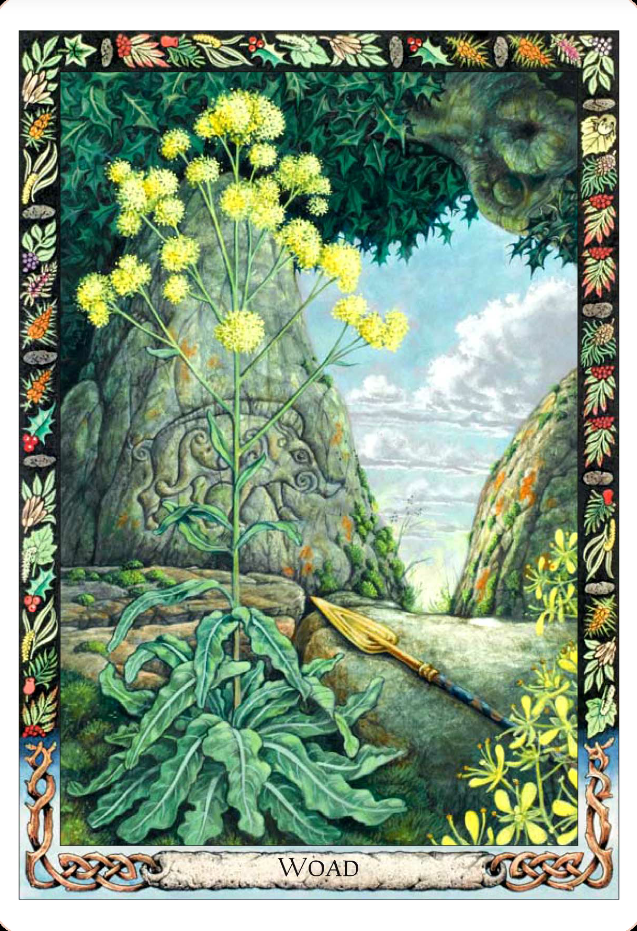
My today's Druid Oracle card was Woad reversed. It's a tall plant with small yellow flowers and it was used for dying fabric in the olden days of Celtic Druids - in particular the war cloths of the Celtic warriors. The upright meaning of the card is freedom and warriorship (fighting for your freedom and passions, going after your goals), but the reversed meaning is as follows: instead of seeking freedom from something, why not seek freedom for something?

The very things you think are limiting you, might actually be working for your benefit, if you find goals that make your heart sing and rearrange your life to allow you to pursue these goals within what is currently available to you.

An example: I relocated to Australia years ago from Northern Europe because I was completely done with the gloomy climate and the equally gloomy economic situation. I often receive questions from friends and strangers alike, asking how they could get to Australia, because it's their dream, too. When they realise relocation takes a lot of time, money, tenacity and skills and perseverance to tackle bureaucracy, all of them have given up - at first.

However, some explore what's their desire a bit further. For some, it's new experiences and better job opportunities. To others, it's life in the sun, close to the sea. One friend of mine has moved to London for job purposes and is doing fine, and another moved to a Mediterranean island, and is doing equally fine. Both changes were relatively easy and inexpensive to undertake within the European Union (no visa hassle), once they realised what was the real desire. It wasn't Australia. It was something that could be obtained elsewhere, with better chances.

Another example: I work in an office in an area that is not particularly inspiring - truth to be told, it's the opposite of inspiring. I've felt for years I could achieve much more if I just found a better suited role, a more creative one. I've sent countless applications, rewritten my resume a number of times, tried networking, tried pretty much everything any business success guide recommends, with no luck.

Partly, if not mostly, my success was hindered by - - - myself. I'm too comfortable with my current salary and very flexible hours, and have not wanted to sacrifice those by trading off to something more rigid and stressful.

After years of job hunt, I've understood there is no job on earth that would fulfil all my needs: no job - other than working for myself - can offer freedom to do whatever interests me at a time that suits me, and remain intriguing and inspiring day after day.

It took a lot of soul searching and tarot readings and a complete change of perspective to see that my current job is a necessary sacrifice to achieve the lifestyle I want: a comfortable financial position, flexibility, a chance to do my PhD without financial worries, a chance to run my own creative projects like this blog, a chance to set up a rewarding side business without stressing my head off about the initial lack of income.

The moral of the story is: what is it you truly desire? 

You might think you need a new job. But would it actually make you happier?

Yes, you might get rid of some nasty people you don't need around, or release yourself from mind-numbing tasks. But the fact remains that many (if not most) of today's jobs just are by nature boring, repetitive and also come with annoying colleagues. There is no heaven or panacea at the job markets, I suspect. So, ask yourself: what is it that would make you happy? A chance to be more autonomous? Have clearer purpose? Have more time for yourself or your family? A chance to self-develop? Experience something new? Rid yourself of a particular person?

The next step is to devise plan C to achieve what you desire. If you're unhappy with your job and can't get another one, is it possible to rearrange or reallocate some tasks? Transfer to another department, office or city? Go on a training course or take study leave and eventually leverage yourself to a new role? Momentarily rely on your partner's income and/or your savings while you take leave without pay or stress leave to go on full time job hunt?

Or, could you move to a cheaper location to manage with smaller income, if you need to take a pay cut with a new, lower-level or part-time job? Can you take leave without pay, rent your pad and go on a couple of months' holiday in a cheaper country to regain your energy and find inspiration? Move back home to share the living costs with your folks? Or find elements to be grateful for and make them work for your benefit in your current situation? A 180 degree turn in your attitude to see only the benefits and none of the negatives?

A problem I personally have is the tendency to take on too much: obligations, tasks and projects in and out of work. The tarot card 10 Wands picks this perfectly by usually depicting a person carrying a heavy bundle of branches. At some stage picking each one of them felt doable and maybe even a good idea, but too much is too much.

Getting this card in a reading is a clear reminder that now it's time to declutter everything that is not absolutely necessary. Any work task that can be reallocated, should be. Any duty or household chore that could be done by someone else, should be. Any personal project that's mainly a drag now, should be left alone for a while, if not dropped altogether.

One avenue people often overlook is the support of friends. If you hope to change jobs, do you already know people from that field? If not, how could you find them? Talking with people who work in your desired field can also reveal is that what you truly want - does it match your expectations? Are there any associations, networking circles or just friends of friends you could connect with?

My experience is that nearly everyone is happy to meet for coffee to give advice, if that's the only thing you ask. Asking someone else to find a job is a bit too much, but asking tips, information about skills requirements and networking chances is another matter altogether. and the majority of people are more than happy to help, because most of us enjoy seeing someone progress and reach their dreams.

Based on my own experience and people around me, the biggest obstacle between you and a change for better is the blockage caused by stress, which in turn causes lack of perspective, lack of fresh new ideas and lack of energy to execute any plan, no matter if it's A or C. Hence, the most essential task to start with is to release stress, on an ongoing basis.

I strongly recommend doing sports you enjoy (anything from swimming or gentle walks in the park to combat sports or full-on cardio) and/or spending time in nature - either in your back yard, garden or a nearby park, or in the wilderness. Regularly. Preferably multiple times per week.

If you think this is waste of time or an additional luxury you can't do... think again. It's the first brick of your golden road to success and your road can't be built, if you, the builder, are too exhausted to lift a finger or form a proper sentence! I've seen this work with plenty of people, including myself. I would still be in my personal pit of misery had I not relied on sports and nature - in addition to tarot - to gain extra energy to actually see the positives of my current situation.

It's been scientifically proven that natural settings and any form of exercise reduce stress immensely and are the natural release systems to rid your body of stress hormones, the "fight or flight" chemicals we all incur every day. Half an hour per day in nature can make all the difference, because it allows your body to relax and your mind wander freely, to explore and find potential answers.

If you combine the "nature or sports treatments" with exploring your feelings and mindset with tarot, I can almost guarantee your life's direction and chances will start looking much, much better!

Some useful questions to ask from your cards could be for example:

How to be more satisfied with life?
  1. What I think would make me happy but in reality, wouldn't?
  2. What really makes me happy?
  3. How to obtain happiness within my current situation?
  4. What to change to have more happiness?
  5. What to accept (can't change right now)?
  6. What should be my short term goal in finding happiness?
  7. What should be my long term goal in finding happiness?
  8. What is the most urgent thing to do for better well-being?
Woad, Druid Oracles.

Tuesday, 1 March 2016

Find your life's purpose with tarot

I am currently reading Dr. Michael Newton’s book “The Destiny of Souls” (2000) and find it highly interesting. I’ve mentioned before that I’m on the fence about the topics of life after death or a spiritual level existing parallel behind/with the material realm (due to the current lack of scientific back up), but it doesn’t mean I can’t explore this area and it couldn’t make sense to me. 

The concept Dr. Newton discusses is as follows:

Dr. Newton is a hypnotherapist, who started his career as a “normal” counselor. He accidentally bumped in to past life regression in the 1960’s by guiding a client into a life before this current life during a hypnosis session that was supposed to track the root cause of an issue the client was suffering from. The root cause was discovered, but not from the client’s childhood, from a past life.

Because the ability or tendency to “travel back to a previous life/lives” and also "life between lives" seems to be something many (if not all) people can do under hypnosis and the stories relayed are structured, meaningful and consistent (instead of meaningless or imaginative blabbering), Dr. Newton has spent decades in unlocking the mysteries of the soul.

To his clients and himself, we are not mere mortal, bio-electro-chemical flesh computers, but spirits (or unknown intellectual life forms) being born time after time into the material world temporarily, before returning back to the timeless mental dimension or the “spirit world”. 

According to Dr. Newton’s clients, the material world, including Earth, are an “exercise ground” to the mental beings who incarnate to learn lessons, practice mental capabilities, enjoy and suffer existence in the material realm and ingrain experiences and emotions into the spirit/soul to grow and evolve.

In essence, it has a lot to do with “willpower’s or mind’s triumph over matter”, which is the essence of growth for this soul being (i.e. the real us). It’s not so much about limiting oneself, but more about overcoming instinctive responses such as fear, anger, lust, greed or resent to live life to the fullest and push oneself to become something more and better than we were before: it’s all about integrity, intention and follow-through.

Dr. Newton has studied thousands of cases and does so in a diligent manner of someone who maps an uncharted territory with care, open mind and gathering samples (interviews under hypnosis) that seem to all support this theory.

As an interesting parallel, another Newton is famous for his scientific discoveries, but he was also shunned by the scientific circles due to his interest in occult: Isaac Newton (1642-1726) discovered gravity and developed the quantitative research method to gather evidence and observe it to deduce the facts, but his ties with the scientific community were cut due to his interest in alchemy.

According to Dr. Michael Newton, the most common question people ask when booking a regression hypnosis session is to discover their true purpose in life

I can’t possibly verify whether Dr. Newton is correct with his model about the real purpose of human life (to teach the soul to grow), but due to my own PhD studies in the area of quality of life I am certain about one thing: we are physical, emotional, mental and social beings, but also aesthetic (seek pleasure from beauty and experience the world through senses and emotions) and spiritual beings, no matter what’s causing this.  

Also, we all seem to have an innate need for purpose. The less purpose we see in our life and its trials and tribulations, the more likely it is we’ll become cynical and eventually depressed. Clearly living without purpose does not gel well with the human mind.

So, what can tarot do to help us find purpose? A lot!

Here’s a spread to discover what your purpose in life is. I personally think we can have a number of different purposes and possibly once one purpose is fulfilled, we can move to another, or run with different purposes simultaneously. But in case you’d like to identify one core theme for your life, this spread can help. This spread is an adaptation from the Where to find joy – spread, discussed in this blog post and created by Paulina Cassidy for Joie de Vivre tarot deck.

My purpose in life – spread.

This reading is done with Fool’s Dog app and it mixes different decks for added visual cues.

1. What is my purpose? ACE OF PENTACLES, Bonefire deck

The beginning of anything material, the seed, the opportunity, good luck. My purpose is to experience the material world in general: the joys and donwsides. But it’s also to find and unlock opportunities, and provide these to others where I can. This is very much how I live my life so I’ve clearly “accidentally” bumped into my purpose! My card shows a big golden pentacle surrounded by vegetation of different seasons, giving the card a bit Wheel of Fortune-like appearance, reminding of life’s ups and downs but also good luck, destiny, taking the opportunity when it comes, as well as enjoying nature in all its glory. The pentacle has a keyhole and a diamond on it, highlighting the “unlock the opportunity” message.

2. Where to find purpose? 9 SWORDS, Joie de Vivre deck 

This card shows a cat climbing up a tree, but it has stopped its progress towards the reward (smiling hearts) at the top of the tree because there are piranha-like creatures flying around and nagging at it. 9 Swords block the way down, so the cat just sits there, paralysed by fear. This card is an excellent reminder of how to deal with other people: don’t let others’ opinions stop you from living your purpose. There’s no point in worrying what others will say, what the society will think, what the neighbour will think: it’s your life, no one else’s! Go after the goal, the smiling hearts, the fulfilled feeling of happiness. For my purpose, this can also mean that I should encourage others to care less about what random people or relatives think and go after what resonates and feels right in life.

3. Where to work to find purpose? (this doesn’t necessarily or only mean your career, but an area in life or a mindset to adopt to find purpose) HANGED MAN, Gaian Tarot. 

This card shows a yogi-like female hanging from a tree, looking relaxed and calm. She has a faint smile on her face and her clothes reflect the blue skies (or you can see through her body to another dimension, possibly). Staying put, learning from being quiet and inactive, and letting the revelation come at its own pace are what are needed. There is inner brewing going on and this period of suspension is for my own good in the long run. Indeed, I’d like a lot of things happen now, such as many of my ideas take off, but I clearly need to wait, ponder and let them mature on their own still. The universe and all its answers are within me, if I know how to look.  

4. What are you allowing to block your purpose? HERMIT, Gaian tarot. 

This card shows a monk-like hooded figure sitting under a tree with a note book and a pen. He’s observing the nature around him: the owl and some spirit animals in the background. I take this to mean that my tendency to spend a lot of time alone, thinking, studying and writing, is hindering my purpose if taken to extreme. I can’t find and unlock opportunities for myself or others by sitting at home in front of a computer. I also can’t experience the material world and the wonders of nature if I’m merely observing, not participating – living in my head, not in my body. Point taken.

5. Purpose mentor - who or what can help me find purpose? 4 PENTACLES, Victorian Fairy deck.

This card shows an elderly fay holding on tight on acorns, when a squirrel is after the same ones. This card is a reminder to not be too attached to material and not too protective and risk-averse in life. Let go of what you have to experience something new. However, it can also mean that it's good to be protective and keep things as they are: there's no need to go after something more materially. Given that I'm already quite unattached to materia, I think this could mean not to worry about money when seeking my purpose, but also that I already have everything I need in the material and physical sense to explore and experience my purpose. 

6. Universe’s gift – what helps you to find or live your purpose? EXPLORER OF FIRE (PAGE OF WANDS), Gaian tarot.

This card shows a tribe member dancing by swinging a burning pot in a rope. It’s all about taking risks just for fun, exploring something new and exciting, finding inspiration from something uncharted. This is very much what I do all the time in a mental level (research on a number of creative topics) but I also like adventurous life, trying new things and experiences. Continuing to live with this attitude clearly is beneficial to me. Thank you tarot! 


Friday, 26 February 2016

How to solve an argument with tarot

In my view, tarot is most useful for self-development, because pulling cards for oneself and pondering the message – and then taking action to do whatever needs to be done – is a direct improvement or problem solving opportunity. 

But, we don't live in a vacuum, and nor are we islands. We all interact with other people every day and the majority our problems are not caused by only us, but they are caused, triggered, related to or made worse by others. How to use tarot to solve a curly situation with someone else?

Firstly, there are at least two schools in tarot about reading about other people’s thoughts and emotions. Some people think that we should never ask how someone else feels or thinks, because it’s prying and morally wrong. 

I’m with the opposite school. I think that we as people are always trying to figure what the other people are up to – either directly by asking or indirectly by trying to deduct or guess based on our own experience and earlier encounters with the said person – so it’s impossible to live a human life without trying to understand other people. 

If cards can help us to understand others better and build bridges between people, then I think it’s justified to try and use tarot to figure what's going on in someone else's head and heart. 

What absolutely needs to be remembered when trying to pick someone’s else’s feelings and thoughts with tarot is that:

a) if tarot is “supernatural” and really can pick someone’s thoughts, then it is more direct spying than guessing: “spying” comes with a moral obligation to not use the knowledge against the person; and
b) never trust the cards blindly.

It’s still possible that your take on the card is not correct, or it shows just a tiny snapshot of the person’s inner workings, or the situation changes rapidly and the person doesn’t think that way in the long run (life is fluid and ever-changing anyway), or your interpretation of the emotion is wrong (say: you see someone’s sad, think it’s because they deeply miss you, whereas they’re sad due to self-pity about losing the fight with you).

So, what could you ask to help navigate a difficult situation?

How to solve an argument - spread

This exercise spread is for me and a relative: we don’t see eye to eye. My relative is sure that certain conspiracy theories are true, whereas I think they are nonsense. Consequently, we end up ruining happy family gatherings by arguing about this.

What is the real core of the issue (the bone to pick)? 2 SWORDS

Indecision and lack of clarity, but also two minds going to completely different directions. My truth simply is different to her truth, and they do not align or combine well. World is not black and white and everything can be seen from different angles - I guess I better remember this and acknowledge that neither of us has all of the facts nor absolute clarity about how things really are.

How do I see this issue? ACE OF PENTACLES

I think it’s mainly about money and greed: these conspiracy theories (e.g. climate change is a hoax) are motivated by the need to earn more and more (big oil and gas businesses wanting to secure profit). It’s also about focusing only on the material world at the expense of any other, including spiritual or scientific take: if you only focus on what you can directly experience with your senses, you’ll miss a lot of data about the world - such as is there more air pollutants or not in the atmosphere? If you can’t see them, it doesn’t mean it’s not true.

How does the other person see this issue? 6 CUPS

I think the person just wants to secure a happy, safe life to her and her family, with no need to worry about how someone’s going to take it all away one day and ruin the carefree, easygoing existence. The person also wants to go back to the past where no such things as climate change were ever heard of and hence, didn’t cause any trouble or hassle to anyone. It was a life of simply enjoying existence without having to worry about overpopulation, allocation of resources, environmental protection, survival of human kind etc.

Why is it important to me to be right? 10 CUPS

To ensure happy coexistence, environment and atmosphere for the extended family. I’m done with arguing, I’d just like everyone to enjoy each other’s company and live in harmony.

Why is it important to the other person to be right? EMPEROR

This card talks about control and power, but also permanence and solidity in life: the bed rock of one’s life. It’s possible this person wants to expose the authority that is (in her view) wrongly exerted upon people (environmental taxes etc.), or, she would want to have a solid ground how to live, without having to worry how these evil forces of the world want to disrupt her lifestyle by imposing rules.

What is the ideal solution for me? 2 CUPS

To understand each other, see eye to eye, be able to connect, listen and be heard – and feel happy about the existence and company of each other. Yes, that would be ideal.

What is the ideal solution for the other person? 7 CUPS

I suspect this means she’d like me to see the world like she sees it: see all those opportunities and threats that surround us, use my imagination more, accept that not everything is like the “mainstream media” wants to present it, that there can be more going on behind the closed doors.

What is the middle ground? QUEEN OF SWORDS

Stick to the facts, don’t get emotional. Stay grounded and mature, don’t engage into fights, don’t attack, but cut through any BS with clarity and confidence. There’s no real reason to fight, but, at the same time, there’s no real reason to not stand my ground and present my facts as I know them. And allow this same opportunity to her, too, it’s not just about me.

What action should I take to reach the middle ground? 9 CUPS

Focus on feeling satisfied and happy, and also remember to party. I usually meet this relative in family parties and gettogethers, so focusing on having fun and appreciating the lovely food, drinks and company would work much better than engaging into petty bickering.

The likely outcome if I take the advice? 10 SWORDS

This matter will be put to rest, it will die off. Yes, there might still be some arguments left but eventually we’ll move on, tired. The topic and the thoughts and worries associated to it will just die out, there is no energy and interest left to keep waving these swords at each other. The worst is upon us, it can't get worse than this, so we might just move on. 
*
Of course, using this spread does not guarantee that the other person is willing to cooperate or back off. But at least it gives you clarity on where the other person is coming from, what motivates them, and what would their ideal solution be, so that you can reassess your approach and see if you can offer an olive branch. If you can’t, at least you are better informed in your actions!

When we fight, we normally try to defend either literally or symbolically our existence or our cubs, the beloved "children" (projects, thoughts, feelings, anything we create). Instincts run unchecked. But, what about the other party? Most likely he or she is feeling exactly the same. 

Thursday, 25 February 2016

How to be a better partner?

I bumped into this question on an online forum: should you or should you not change for love?

One valid view is that of course not. If you need to try and change who you are, it’s a dead end road from the beginning. Carving out elements of your personality or trying to fit in someone else’s mold simply can’t work or provide any sort of long-term happiness. Which, I fully agree, is true. Trying to please someone else by being something you are NOT is a surefire way to break your own heart and maybe your own spine and self-esteem, too.

I want to make clear that I’m pretty much the last person on earth who wants to advocate bending over backwards for someone else.

I’ve had my own issues with clingy and co-dependent people, and I’ve went through a crash-course about how to deal with and survive from a manipulative narcissist, so I strongly encourage everyone to stand their own ground. However, there is a difference between being your current self, warts and scales and all, and being the best version of yourself.

Nobody can be perfect, but quite a few of us can be slightly improved, if we first identify what’s not working in and for ourselves and for our relationship. This is quite a self-evident advice but not everyone realises it when they are pining for a relationship, or for a better relationship. The only person you can change is you – and, let’s take an honest look: are you a genuinely nice person to be with?

We’ve all heard about “if you can’t handle me at my worst, you don’t deserve me at my best”, but could that worst be brought into a bit more manageable level?

Does it have to be the Third World War or the annual convention of drama queens or kings, when you’re at your worst? For me it certainly was at some stage, but I eventually realised that I’m not being very fair – nor nice. And why would I want to put my beloved through such a misery in the first place – I love him more than anything in the world, and I want him to know it, every day of the year.

Here’s a spread I created to examine this very question, and my own sample reading.

How to be a better partner?

  1. What is my overall partnering style (how do I behave in a relationship)?
  2. With who am I compatible with?
  3. What is something my partner(s, ex and current) like about me?
  4. What is something my partner(s, ex and current) dislike about me?
  5. What should I leave behind to be a better partner?
  6. What should I embrace to be a better partner?
  7. What action should I take to find/build/maintain a fulfilling relationship?

- - 7 - -
- 5 - 6 -
1 - 2 -3 - 4


What is my overall style of being a partner? 8 CUPS

I’m always searching for something new in my life, I’m never fully satisfied. This card is and is not true, depending on the angle. I aspire to commit for life and when I’m in love, I believe it will last forever. Of course sometimes things change and it won’t, but I’ve always been in lasting relationships and the current one – marriage to my soulmate – for all intents and purposes is supposed to last for a lifetime and beyond. 

However, in every other area in my life I’m always in search for more – or something new. I like experiencing new things and I get bored easily with hobbies, work etc. I blame my Gemini moon for this insatiable thirst for new knowledge, new emotions, new experiences, new viewpoints. And I keep dragging/inspiring my partner to this quest, too. I pretty much have a new plan for my/our life every week and some of those plans transpire to action, some don’t, because I come up with a new, even “better” plan.

With who am I compatible with? LOVERS

With my soulmate, duh, thank you tarot. With the person who makes me feel that he is the choice of my mind, heart, body and soul: when the relationship makes me feel all these aspects of myself are in perfect alignment and it feels like it’s a match made in heaven.

What is something my partner(s) like about me? ACE OF PENTACLES

I’m a solid choice, I guess. As I said, I commit and see the value of the relationship. I’m also crafty and always on the lookout for new opportunities: to earn money, grow as a person, learn something new, network, find and incorporate something new and interesting into my/our life. I’m also the “cheerleader” or the life coach of my partner, trying to find job opportunities for him and supporting him through the application process from writing the resume together to coaching for the interview.

What is something my partner(s) dislike about me? PAGE OF SWORDS

Hmm. I’m an eternal student and currently I’m studying towards a PhD degree. I simply love learning and I dwell in areas of my interest for days to an end. I don’t believe my partners necessarily dislike the studious or curious side, but perhaps this pertains to my communication blunders – the immature and inconsiderate side of the Page. I’m known for my stupid blurt-outs and inadvertent heartless comments that I have let escape my lips without thinking. Time to practice, clearly…

What should I put behind to be a better partner? 2 WANDS

This card most often means change of heart to me. It’s a passionate choice, made after an earlier passionate choice. I definitely recognise myself from this flipping back and forth and this relates to the earlier 8 Cups, always on the quest to find fulfilment that never comes. My husband is much more solid with his plans and this sometimes causes distress and tension for him – he feels I’m uprooting him with my flickering plans to move to Japan to teach English, move to New Zealand to own an adventure company, move to Queensland, Australia, to have our own wedding resort… I’ve been learning the hard way that the only way forward in life is to set intention and then follow through with resilience. This butterfly tendency to hop from one plan to another with a moment’s notice is clearly not the most helpful in a relationship, nor is it taking me anywhere, really.

What should I embrace to be a better partner? 9 SWORDS

Stop worrying for nothing. I’m normally easygoing and relaxed, but sometimes I get stuck in a loop of anxieties and worries: why are things not progressing as I’d like? Is something bad going to happen? How can I keep myself and my partner safe from accidents, misfortune etc.? This, again, is not very helpful. Alternatively, this card could simply say “nothing”, stop worrying about needing to be something different or more!

What action should I take to maintain a fulfilling relationship? 2 CUPS. 

Haha, another no-brainer! Be a giving, open and receptive partner: transparent and generous in your emotions and expect the same in return. Love with your full heart and be loved in return.


More of this same topic can be found in this article: how one husband changed the course of his marriage by biting the bullet, stopping the blame game and changing his own behaviour. And what flow-on effects it had on his wife and life. An interesting read! 
2 Cups, Joie de Vivre tarot, Paulina Cassidy. Mutual, equal, shared, true love.